About Andreea
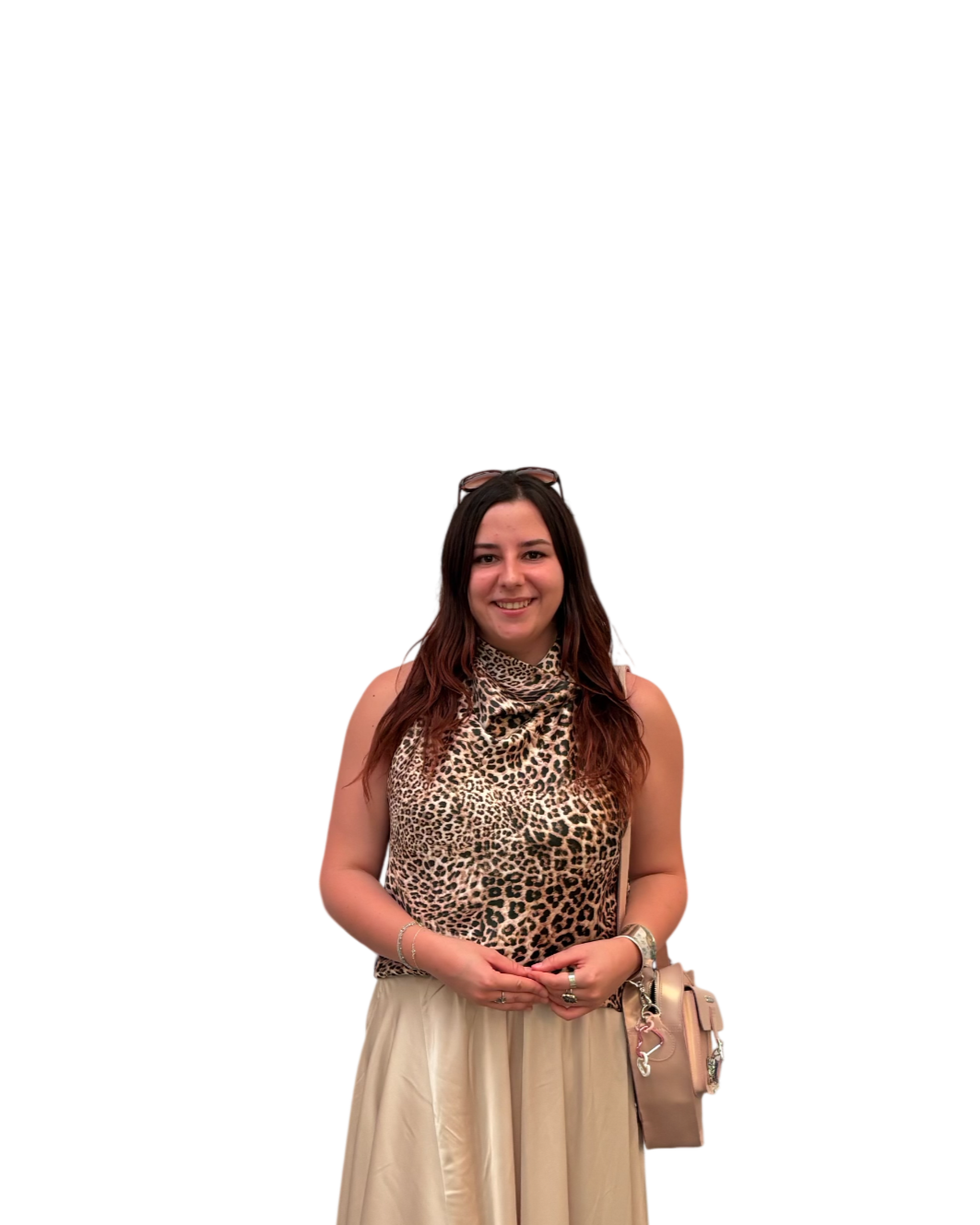
Andreea Popescu has been an artist since before she knew the word for it.
As a child, her parents built her something simple and, in hindsight, quietly formative: a small easel, layered with A4 sheets of paper stuck one on top of the other, so she would always have a fresh page to draw and paint on. That easel became her first studio and her first refuge, a place she could return to whenever the world felt like too much, or not enough. She has been drawing and painting ever since.
That early instinct was nurtured through school, where she chose optional art classes and found teachers who saw something worth encouraging. Cristina Grigoroiu offered early guidance, and for years afterward, through primary, middle, and high school, Magda Morozan became a mentor whose influence has stayed with Andreea well beyond the classroom. Her literature teacher, Dana Stefan, shaped her just as much from a different direction, teaching her to read the world, and later, her own paintings, for meaning beneath the surface.
In high school, Andreea took her art education a step further, choosing IB Visual Arts at Higher Level, a demanding, self-directed course that asks students to build a full body of work, keep a process journal, and articulate the thinking behind every piece. It was her first real experience of treating art not as a subject to pass, but as a practice to sustain: research, iteration, reflection, repeat. Much of how she still works today, returning to a feeling from several angles, letting a piece evolve rather than arrive fully formed, traces back to habits built in that course.
Andreea went on to study Psychology with Education for her bachelor's degree at the University of Leeds, including a placement at the Leeds Refugee Forum, work that deepened her understanding of resilience, displacement, and the quiet ways people hold themselves together. Not long after, a severe allergy and asthma condition forced her to stop and take a gap year to heal.
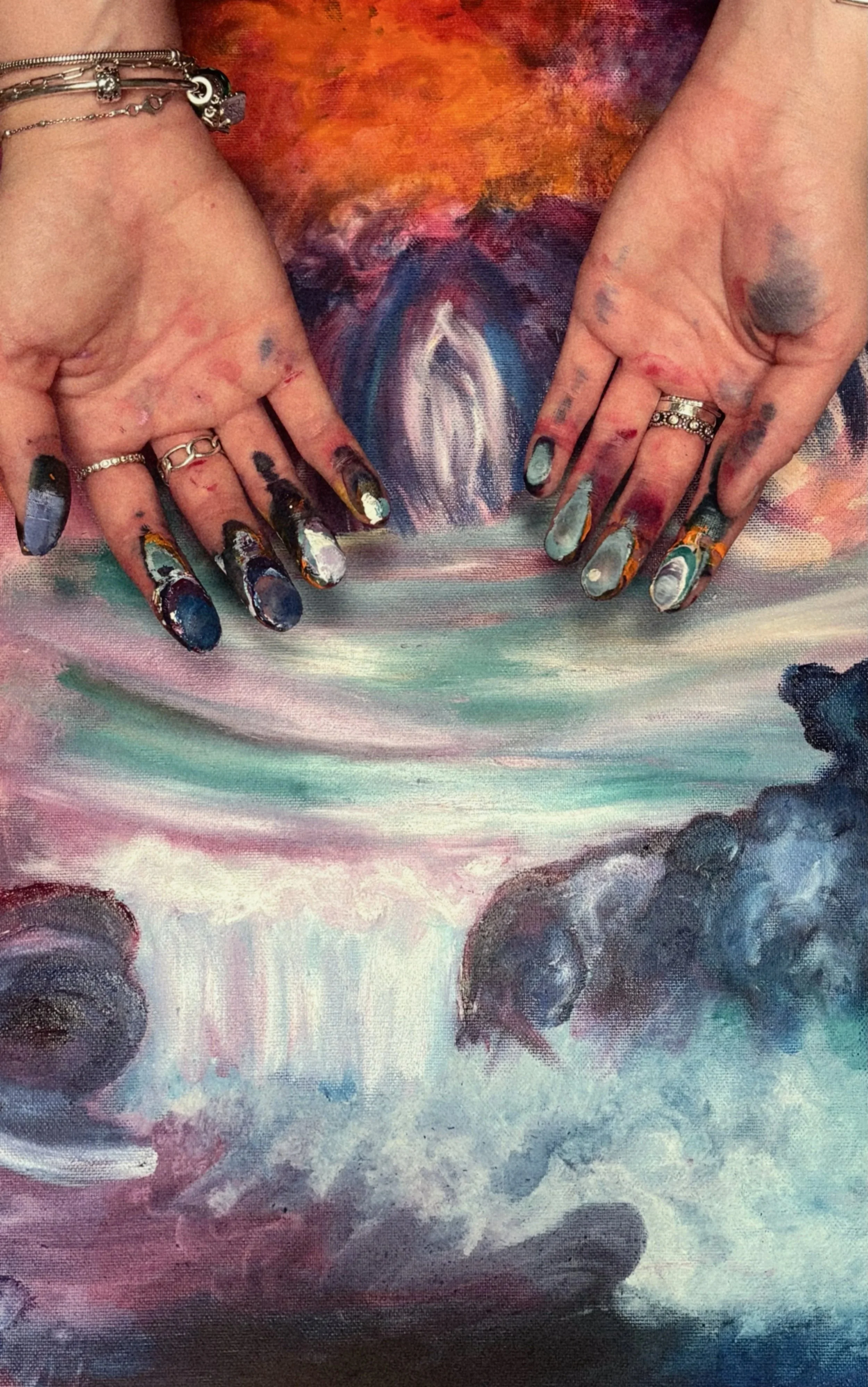
It was in that year, away from academic momentum, closer to her own body and its limits, that Andreea turned back to painting. Not as a technical exercise this time, but as something closer to survival: a way to process what couldn't yet be said out loud. That return marked a turning point. Painting stopped being something she had learned to do well, and became something she needed to do at all.
She carried that instinct forward into her further studies: a master's in Economic Psychology at Tilburg University, followed by a Postgraduate Diploma in Art Therapy and Community Art, and later a Master's in Art Therapy at Metafora, Barcelona. Each step deepened her understanding of why we make images at all, and gave her a framework for something she had already been doing instinctively her whole life.
Alongside her painting practice, Andreea designs jewellery under her brand Equinox, exhibiting at jewellery weeks across Europe and receiving recognition for her work in the field.
Those who know Andreea describe her the same way, again and again: warm, generous, present. She is the kind of person who remembers small details about the people she loves and turns them into gestures, a gift, a note, a painting. She spends as much time outdoors and in motion as she does at the easel, and that same appetite for life, for weather, for movement, for people, is what keeps returning to her canvases as light, water, growth, bloom. Her energy tends to lift a room before she's said a word. It's the same energy that carries through her work: even the darkest, most turned-inward pieces hold a thread of warmth somewhere inside them.
Artist Statement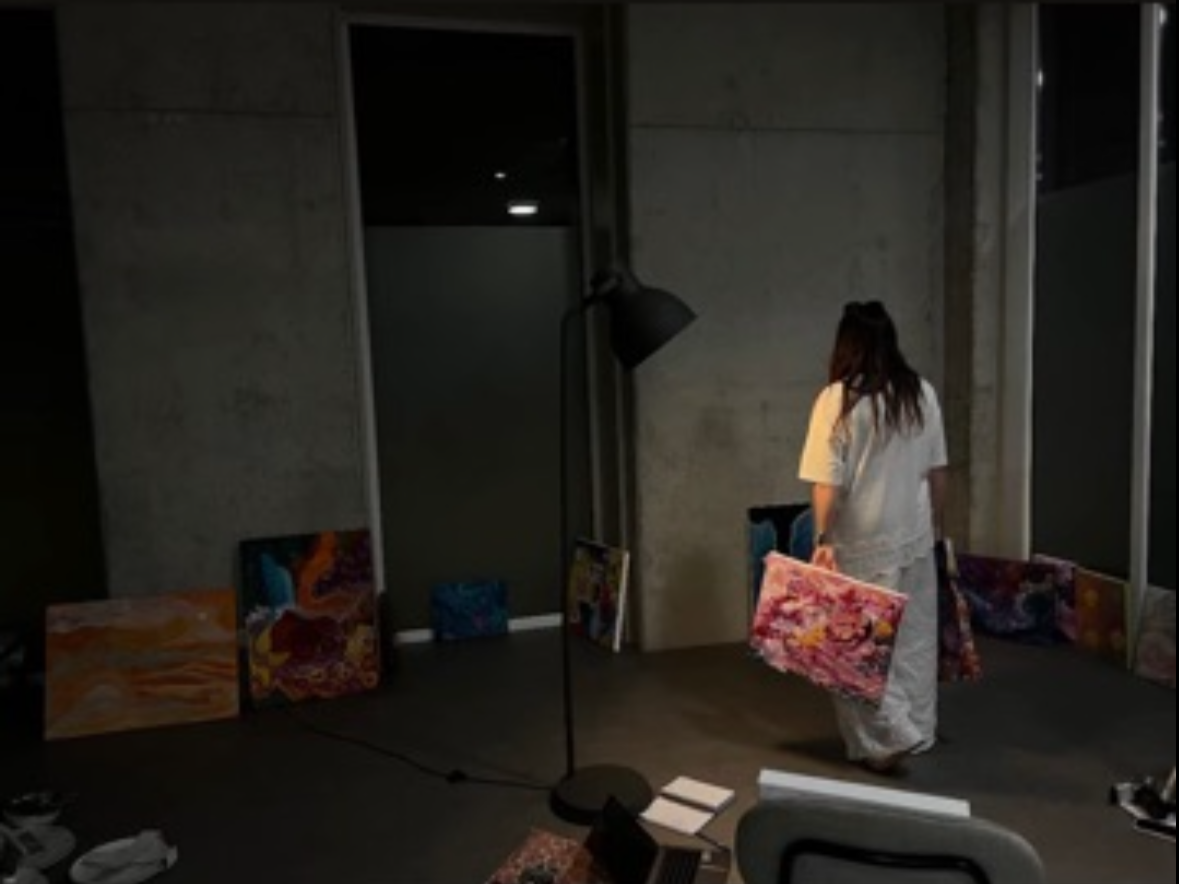
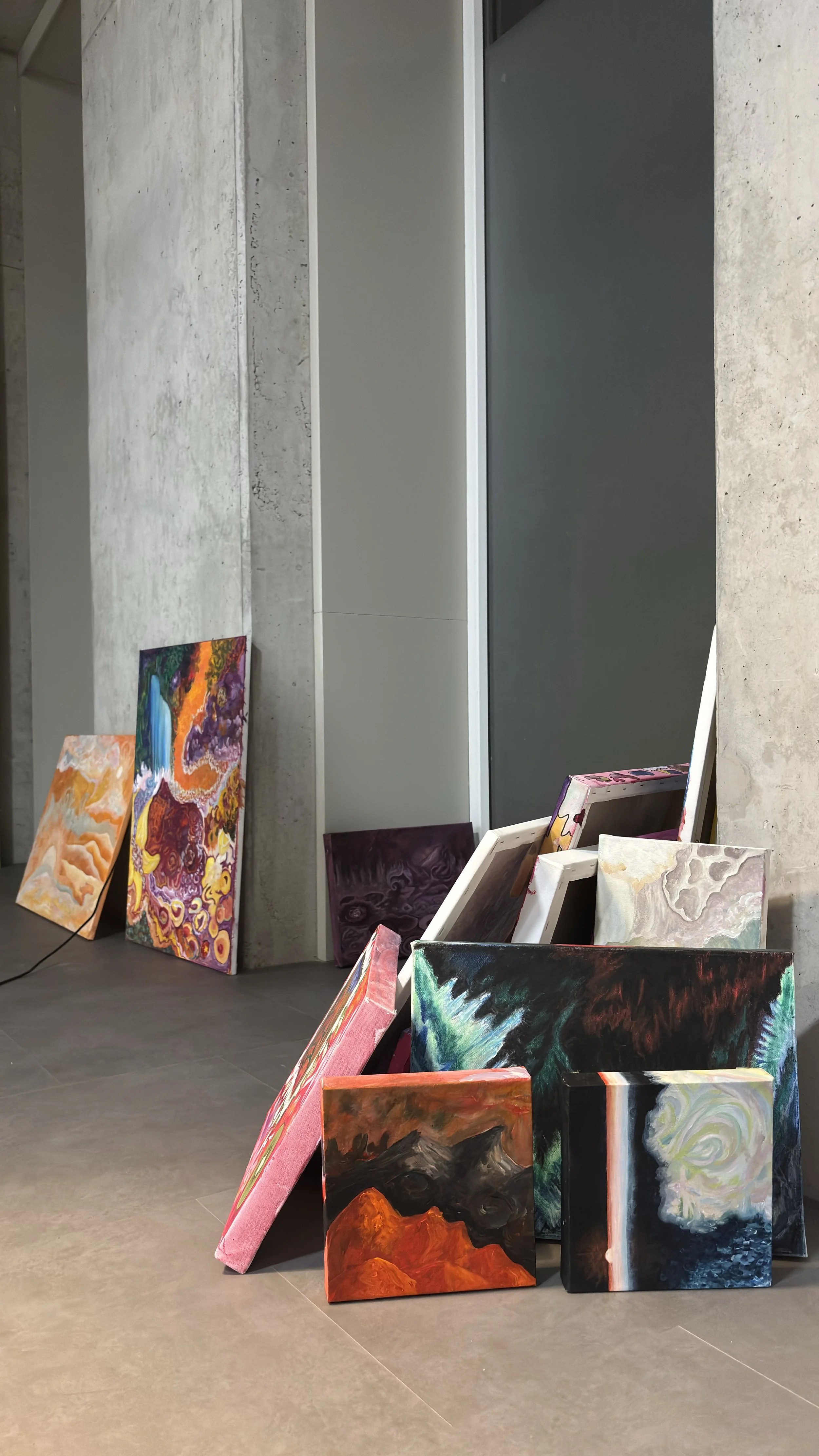
‘I paint the way some people keep a diary, as a way of finding out what I actually feel, rather than what I think I should feel.
Each piece is a mirror of my inner world at a particular moment: not a planned message, but something closer to a trace, left behind after the fact. I carry with me everything I learned in years of formal art education, composition, technique, colour, the quiet rules that make an image hold together, but I no longer approach painting as a discipline to master. It's an exploration. A form of play. A way through.
A lot of my process now starts with a question, often not my own. I ask the people close to me for a word, an image, a feeling, a prompt, and I let it lead me somewhere I wouldn't have gone on my own. It keeps the work honest. It keeps me from painting only what I already know how to paint.
If there's a single thread running through everything I make, it's love, chasing it, missing it, sitting inside it, or feeling its absence. I paint out of love, and when love isn't there, I paint that too. Either way, what ends up on the canvas is real. That's the only rule I've kept.’